
- Buy Crypto
- Markets
- Futures
- Spot
- Copy Trade
 WE-Launch
Decentralized Exchange (DEX): Benefits, Risks, and How It Works in 2026

A Decentralized Exchange (DEX) is changing how people trade crypto. Instead of depositing funds into a company-controlled account, a Decentralized Exchange (DEX) lets users swap tokens directly from their own wallets through smart contracts. In 2026, the Decentralized Exchange (DEX) model is no longer just for DeFi power users. It is now a mainstream part of crypto market structure.
That matters because more traders now care about self-custody, transparency, and direct access to on-chain markets. But DEXs are not automatically better in every situation. They offer real benefits, yet they also come with real risks, including smart contract bugs, slippage, MEV, and weak token quality. If you are new to crypto, this guide explains what a DEX is, how it works, which major DEXs matter in 2026, and what to watch before making your first trade.
What Is a Decentralized Exchange (DEX)?
A Decentralized Exchange (DEX) is a peer-to-peer crypto marketplace that executes trades on a blockchain through smart contracts. Users connect a wallet, approve a transaction, and settle the trade on-chain instead of trusting a centralized platform to hold funds and process orders internally.
This is the biggest difference in the DEX vs CEX debate. A centralized exchange usually controls custody, order matching, and settlement inside its own systems. A DEX removes that central custodian from the trade itself. The protocol handles execution, while the user keeps control of the wallet.
For beginners, this creates three obvious advantages. First, you keep custody of your assets. Second, transactions are transparent because settlement happens on-chain. Third, a DEX often gives faster access to new ecosystems and tokens.
But there is a tradeoff. On a DEX, you are more responsible for what you sign, which token you buy, which contract you approve, and how much slippage you accept. More control also means more responsibility.
How a Decentralized Exchange (DEX) Works
Most DEXs today use either an automated market maker (AMM) model or an order book model.
An AMM uses liquidity pools rather than matching a buyer and seller directly. The basic AMM formula is:
x * y = k
Here, x and y are the quantities of two assets in the pool, while k stays constant. When someone buys one asset, the balance changes, and the price adjusts automatically to keep the equation in balance.
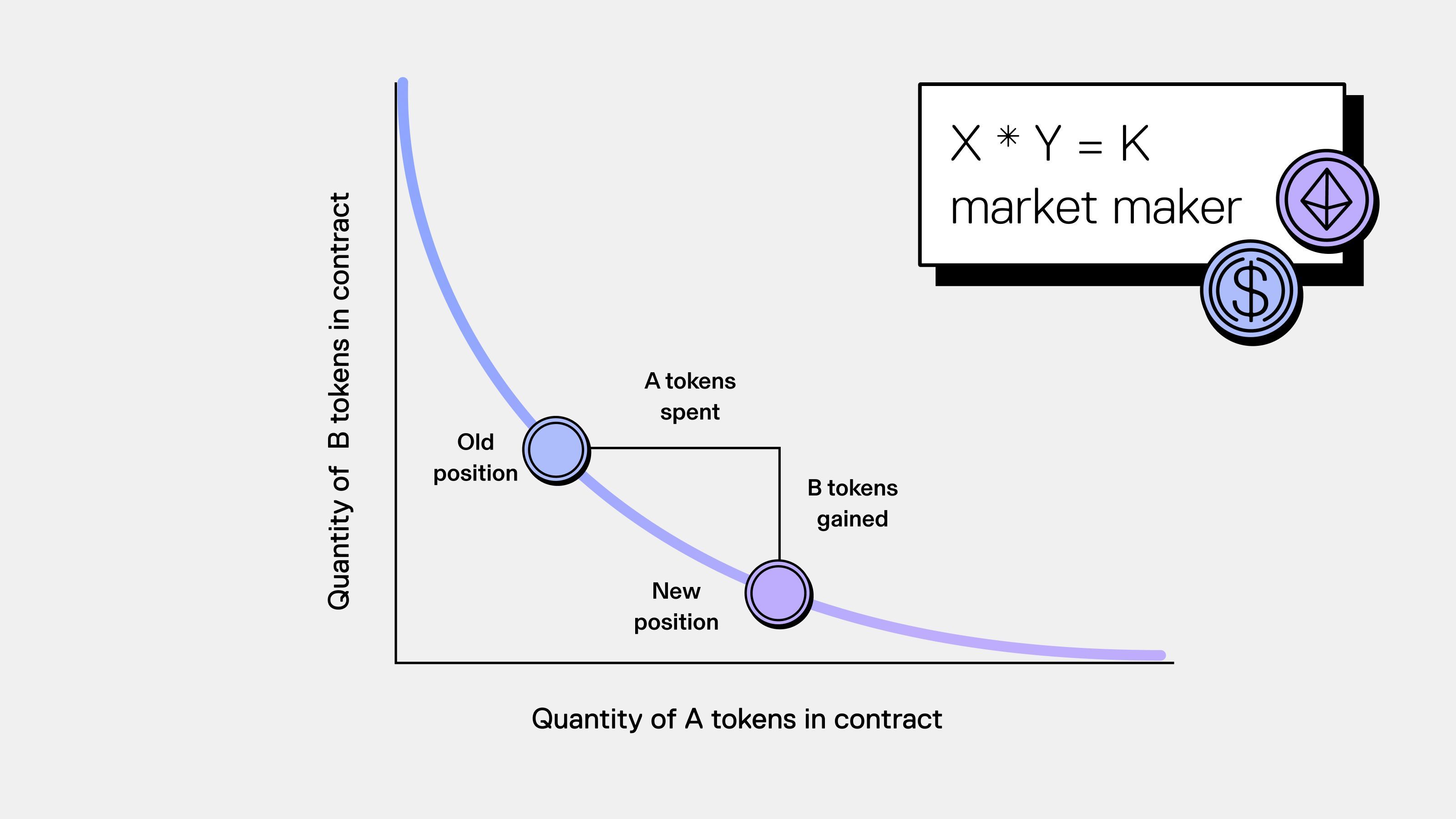
A simple example helps. Imagine a pool with 100 ETH and 265,000 USDT. If a trader buys ETH from that pool, the ETH balance falls and the USDT balance rises. Because the ratio changes, the next buyer pays a higher price. This is why larger trades on smaller pools often create more price impact.
Other DEXs use an order book, where users place bids and asks just like on a more traditional exchange. These platforms are often better for traders who want precise entries, visible market depth, and advanced order types. In 2026, faster chains and Layer 2 networks made decentralized order books more practical than they were a few years ago.
There is also a newer approach called intent-based trading. Instead of manually choosing the route, users state the result they want, and external solvers compete to provide the best execution. This model is becoming more relevant because it can reduce routing inefficiency and improve execution quality in fragmented multi-chain markets.
DEX trading also includes network fees. On Ethereum-style networks, gas cost is commonly expressed as:
Gas Cost = Gas Used × (Base Fee + Priority Fee)
That matters because a low swap fee can still become an expensive trade if the network is congested.
Benefits and Risks of Using a Decentralized Exchange (DEX)
The biggest benefit of a Decentralized Exchange (DEX) is self-custody. You keep control of your private keys and do not have to trust an exchange to hold your assets. After years of exchange failures, hacks, and frozen withdrawals in crypto, this remains one of the strongest reasons people prefer DEXs.
Another major benefit is transparency. A DEX settles on-chain, so liquidity, transaction history, and contract behavior are more visible than they are inside a closed internal ledger. DEXs also support permissionless access, which means users can often reach new assets and ecosystems faster than they can on centralized venues.
But the risks are just as real.
The first is smart contract risk. If the protocol has a bug or the user interacts with a malicious contract, funds can be lost. The second is slippage, which can hit hard when liquidity is shallow or volatility spikes. The third is impermanent loss, which affects liquidity providers when the relative price of pooled assets changes sharply. In that case, the provider may end up with a worse outcome than simply holding the assets in a wallet.
Then there is MEV, or maximal extractable value. On public blockchains, bots can monitor pending trades and sometimes profit by moving around them. This is one reason sandwich attacks remain a known issue in DEX trading.
So a DEX does not remove risk. It shifts risk from a centralized company to the user, the wallet, and the protocol design.
Mainstream DEXs Beginners Should Know in 2026
Not all DEXs do the same job. In 2026, several names stand out because of their liquidity, adoption, or market niche.
Uniswap remains one of the most recognized DEXs, especially for Ethereum and major Layer 2 users. It is still the clearest example of an AMM-based decentralized exchange.
PancakeSwap continues to be highly relevant for retail traders, especially in BNB Chain and broader multi-chain token markets.
Jupiter is one of the most important names in the Solana ecosystem because it acts as both a trading interface and a major routing layer for swaps.
Raydium remains a key Solana DEX for liquidity-pool-based trading and access to Solana-native token activity.
Aerodrome has become a major liquidity hub on Base, which matters because Base keeps growing as a retail-friendly on-chain environment.
CoW Protocol stands out for users who care about execution quality and MEV-aware design, thanks to its batch-auction and solver-based model.
For beginners, the takeaway is simple: the best DEX depends on the chain, the token, the liquidity depth, and the kind of trade you want to make.
Why DEXs Matter More in 2026
The rise of DEXs is not just a theory story. It is a market-structure story.
Our research brief shows that by early 2026, decentralized exchanges were facilitating nearly 20% of global spot trading volume. That is a major shift. It means DEXs are no longer a small DeFi corner. They are now a serious part of crypto trading infrastructure.
A big reason is cost and speed. Layer 2 networks and alternative high-throughput chains made DEX trading much more practical for normal users.
Snapshot of DEX Trading Costs in 2026
| Network | Avg. Swap Fee (2026) | Approx. TPS | Why It Matters |
|---|---|---|---|
| Ethereum L1 | $5.00 to $40.00 | ~15 | Deep liquidity, but expensive for smaller users |
| Arbitrum One | ~$0.0044 | ~400 | Strong DeFi liquidity with lower cost |
| Base | ~$0.0161 | 1000+ | Retail-friendly and easier for everyday swaps |
| Optimism | ~$0.0007 | ~300 | Very low-cost on-chain trading |
| Solana | <$0.001 | 2000+ | Fast and cheap for active trading |
These numbers explain why DEX usage kept growing. When on-chain execution becomes fast and cheap enough, more users are willing to trade without giving up custody.
Conclusion
A Decentralized Exchange (DEX) gives users direct access to crypto trading through wallets and smart contracts instead of centralized custody. That creates meaningful advantages, including self-custody, transparency, and easier access to on-chain markets. But a Decentralized Exchange (DEX) also comes with real tradeoffs, including smart contract risk, slippage, impermanent loss, and MEV-related execution problems.
If you are new to crypto, the best approach is not to treat every DEX as automatically safe or automatically better. Start small, use trusted protocols, verify token contracts, and understand every approval before signing. Once you understand how a Decentralized Exchange (DEX) works in 2026, you will be in a much better position to trade on-chain with confidence.
FAQ
What is a Decentralized Exchange (DEX)?
A Decentralized Exchange (DEX) is a crypto trading platform that lets users trade directly from their own wallets using smart contracts.
How does a DEX work?
Most DEXs use AMMs or order books. AMMs rely on liquidity pools and pricing formulas, while order book DEXs match bids and asks more directly.
What are the main benefits of a DEX?
The main benefits are self-custody, transparency, permissionless access, and direct participation in DeFi markets.
What are the main risks of a DEX?
The biggest risks include smart contract bugs, slippage, impermanent loss, MEV, scam tokens, and user mistakes.
Which DEXs are popular in 2026?
Among the best-known names in 2026 are Uniswap, PancakeSwap, Jupiter, Raydium, Aerodrome, and CoW Protocol.


 App
App