
- Buy Crypto
- Markets
- Futures
- Spot
- Copy Trade
 WE-Launch
Spot vs Futures vs Margin Trading: Key Differences Every Crypto Beginner Should Know

For anyone entering the world of cryptocurrency, one of the first questions that appears is simple but confusing: what is the difference between spot trading, spot margin trading, and futures trading?
If you have ever opened a crypto exchange and seen buttons labeled Spot, Margin, or Futures, you probably wondered whether they are just different names for the same thing. In reality, they represent three very different ways of participating in the crypto market.
Understanding the difference between spot trading, spot margin trading, and futures trading is essential because each method changes how you manage risk, how much capital you need, and how you profit from market movements.
Think of it like transportation. Spot trading is like buying a car outright. Spot margin trading is like buying the car with a loan. Futures trading is more like making a bet on whether car prices will go up or down in the future.
Once you see the market through that lens, the structure becomes much easier to understand.
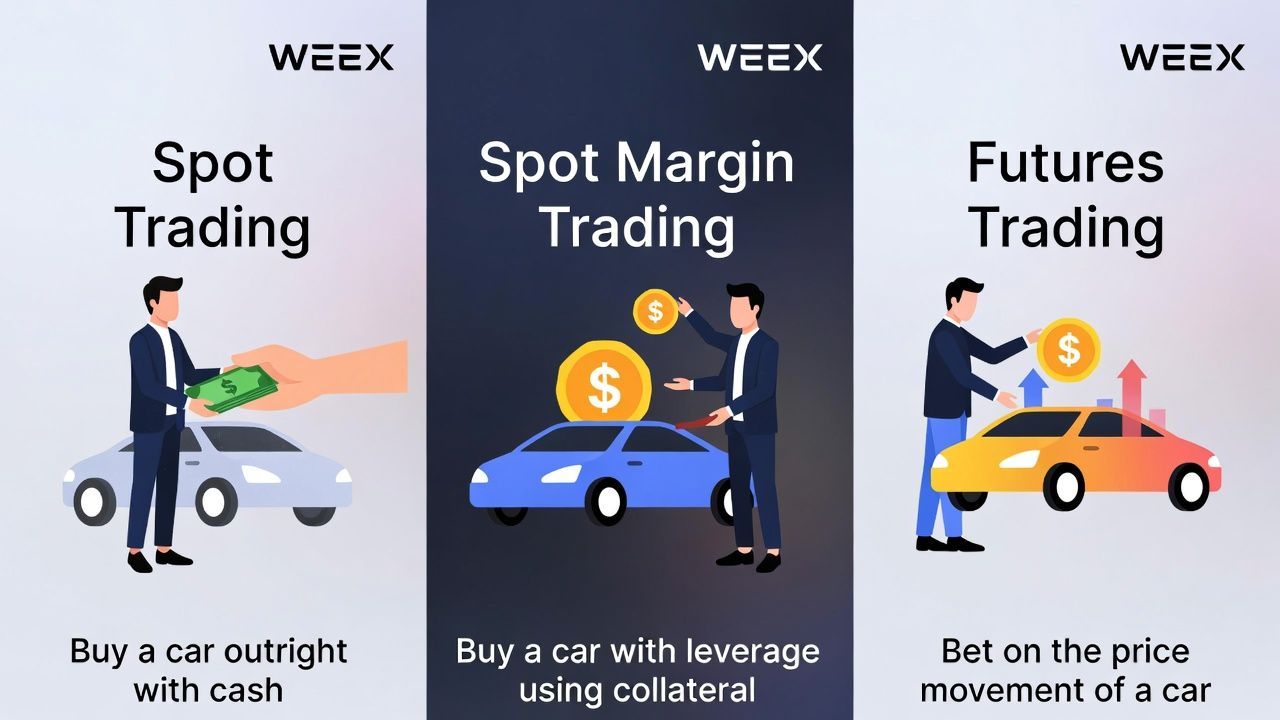
What Is Spot Trading? The Simplest Way to Buy and Sell Crypto
Spot trading is the most straightforward way to buy and sell cryptocurrency. When you participate in spot trading, you purchase a cryptocurrency and own the asset immediately.
If you buy Bitcoin through spot trading, the Bitcoin goes directly into your wallet or exchange account. There are no loans, no leverage, and no expiration dates. What you own is real crypto that you can hold, transfer, or sell whenever you choose.
Because of this simplicity, spot trading is often compared to buying stocks or commodities. You exchange your funds for an asset at the current market price, also known as the spot price.
Imagine buying Bitcoin at $60,000 through spot trading. If the price later rises to $70,000, you can sell the Bitcoin and keep the profit. If the price falls, your asset value decreases, but you still own the Bitcoin itself.
This is why spot trading is widely considered the most beginner-friendly method in the crypto market. There is no borrowing, no liquidation risk, and no complex mechanics behind the trade.
Many newcomers start their journey through spot trading before exploring more advanced instruments.
What Is Spot Margin Trading? A Leveraged Way to Increase Buying Power
While spot trading requires you to use only the funds you already own, spot margin trading introduces borrowing.
In spot margin trading, traders can borrow funds from the platform in order to increase their buying power. This borrowed capital allows traders to open larger positions than their current balance would normally allow.
Imagine you have $100 but want to open a $500 trade. With spot margin trading, the platform can lend you the additional funds needed to complete the trade. This creates leverage, meaning your profits and losses become amplified.
If the market moves in your favor, spot margin trading can significantly increase your returns. However, if the market moves against you, the losses also grow faster.
The key difference between spot trading and spot margin trading lies in the use of borrowed funds. When borrowing is involved, the platform requires collateral and charges interest on the borrowed amount.
Because of this, spot margin trading introduces the possibility of liquidation. If the value of your collateral falls below a certain threshold, the system may automatically close your position to repay the borrowed funds.
Despite the additional risk, spot margin trading remains popular among traders who want greater exposure to market movements while still trading directly in the spot market.
What Is Futures Trading? How Traders Profit from Crypto Price Movements
While spot trading and spot margin trading involve actual cryptocurrency ownership, futures trading works differently. Instead of buying the asset itself, traders are speculating on the future price of that asset.
In futures trading, you are essentially entering a contract that reflects the price movement of a cryptocurrency such as Bitcoin or Ethereum. The trader does not necessarily own the underlying asset.
One of the biggest advantages of futures trading is the ability to profit whether the market rises or falls. Traders can open a long position if they believe prices will increase or a short position if they believe prices will decrease.
This makes futures trading especially attractive in volatile crypto markets where prices can move dramatically in both directions.
Another defining feature of futures trading is leverage. Futures platforms often allow traders to open positions worth many times their initial capital. For example, with 10× leverage, a $100 margin can control a $1,000 position.
However, leverage also increases risk. If the market moves against the trader, losses can accumulate quickly and may trigger liquidation.
Within futures trading, there are two main contract types: futures contracts with expiration dates and perpetual contracts without expiration.
Traditional futures contracts settle at a predetermined time, while perpetual contracts allow traders to keep positions open indefinitely.
Comparison Between Spot Trading, Spot Margin Trading, and Futures Trading
Spot Trading | Spot Margin Trading | Futures Trading | ||
Futures Contracts | Perpetual Contracts | |||
Market | Spot Market | Spot Market | Futures Market | Perpetual Market |
Expiration Date | N/A | N/A | The expiration date ranges from daily to quarterly depending on the contract. | No expiration date, allowing positions to be held indefinitely. |
Trading Fee | Spot trading fee | Spot trading fee, interest on borrowed funds, and repayment handling fees if auto-repayment is triggered | Futures trading fee and settlement fee | Perpetual trading fee and funding fee |
Leverage | Leverage is not supported. To acquire assets worth 100 USDT, you must have 100 USDT. | Leverage allows traders to borrow funds. For example, with 10× leverage and 10 USDT, a trader can open a position worth 100 USDT. | Leverage allows positions to be opened with smaller capital. For example, a 100 USDT position with 10× leverage requires only 10 USDT as initial margin. | Same leverage mechanics as futures contracts, but without expiration constraints. |
Maximum Leverage | N/A | Up to 10× | Typically 25× to 125× depending on the trading pair | Typically 25× to 125× depending on the trading pair |
Borrowing | Not supported | Traders borrow funds from the platform and interest is charged hourly | Borrowing may apply depending on account structure | Borrowing conditions may apply depending on account structure |
Collateral | Not required | Margin assets act as collateral | Initial margin acts as collateral for opening a position | Initial margin acts as collateral |
Source of Profit | Profit comes from asset price appreciation | Profit comes from amplified price movements using borrowed funds | Traders can profit from both rising and falling markets | Traders can profit from both directions with no expiration constraint |
Liquidation Risk | No | Yes | Yes | Yes |
Which One Should Beginners Use?
For most newcomers entering the cryptocurrency market, spot trading is usually the safest and most intuitive place to start. Because spot trading does not involve borrowing or leverage, traders can focus on understanding price movements and market behavior without the additional pressure of liquidation risk.
After gaining experience with spot trading, some traders begin exploring spot margin trading to increase their exposure to market opportunities. This step requires careful risk management because borrowing introduces additional volatility.
More advanced traders often move toward futures trading, where leverage and the ability to short the market create more complex strategies.
Platforms like WEEX provide a comprehensive trading environment where users can move smoothly between spot trading, spot margin trading, and futures trading depending on their experience level. With professional-grade infrastructure, deep liquidity, and advanced risk-management tools, WEEX has become a trusted platform for both beginners and experienced crypto traders looking to explore different trading strategies in one unified ecosystem.
Final Thoughts: Understanding the Difference Between Spot, Margin, and Futures
The difference between spot trading, spot margin trading, and futures trading ultimately comes down to ownership, leverage, and risk.
Spot trading focuses on direct ownership of cryptocurrency. Spot margin trading expands that exposure by introducing borrowed funds. Futures trading moves beyond ownership entirely, allowing traders to speculate on price direction through leveraged contracts.
Each method plays an important role in the modern crypto market. For beginners, starting with spot trading builds a strong foundation. As knowledge grows, spot margin trading and futures trading can offer additional flexibility and strategy options.
Understanding these differences not only improves trading decisions but also helps traders navigate the rapidly evolving cryptocurrency ecosystem with greater confidence.


 App
App